Choosing between a historic home and something newer in Upper Downtown Charleston can feel exciting and a little tricky at the same time. You may love the charm of an early 20th-century bungalow, but also want easier upkeep, a simpler floor plan, or fewer renovation surprises. In 29403, those choices are especially nuanced because each neighborhood has its own architectural identity, price point, and preservation context. This guide will help you compare the main options so you can move forward with more clarity. Let’s dive in.
Upper Downtown has more than one story
When people picture downtown Charleston, they often think of classic Charleston single houses on older peninsula streets. In Upper Downtown, that image only tells part of the story. The Upper Peninsula has been shaped by a long transition from industrial and commercial roots toward denser housing, modern workplaces, retail, and restaurants.
That matters because your home options in 29403 are more varied than many buyers expect. In Hampton Park Terrace, Wagener Terrace, and North Central, “historic” can mean very different things depending on the block, the building period, and the level of renovation.
The City of Charleston also treats this area as one with distinct neighborhood character. Its Area Character Appraisal program looks at architecture, building forms, landscape resources, and cultural resources, which is helpful when you are trying to understand why one street feels orderly and intact while another feels more mixed or in transition.
What the market looks like in 29403
Recent market snapshots show 29403 as a somewhat competitive area. Over the three months ending in May 2026, the median sale price was $884,737, with an average of 90 days on market.
Within that broader ZIP code, price points vary by neighborhood and by housing type. Redfin snapshots placed Wagener Terrace at $999,664 and North Central at $864,709 in May 2026. Hampton Park Terrace showed a much higher median of $3.2 million in March 2026, though that figure was based on only one recorded sale, so it is best viewed as volatile rather than typical.
For you as a buyer, that means headline numbers only go so far. In Upper Downtown, condition, house type, preservation expectations, and flood-zone specifics can shift both value and day-to-day ownership experience.
Historic does not mean one style
One of the biggest misconceptions in Upper Downtown is that all historic homes follow the same Charleston pattern. They do not. The housing stock in these neighborhoods reflects different eras and lot layouts, so it helps to know what historic really looks like in each place.
Charleston single houses
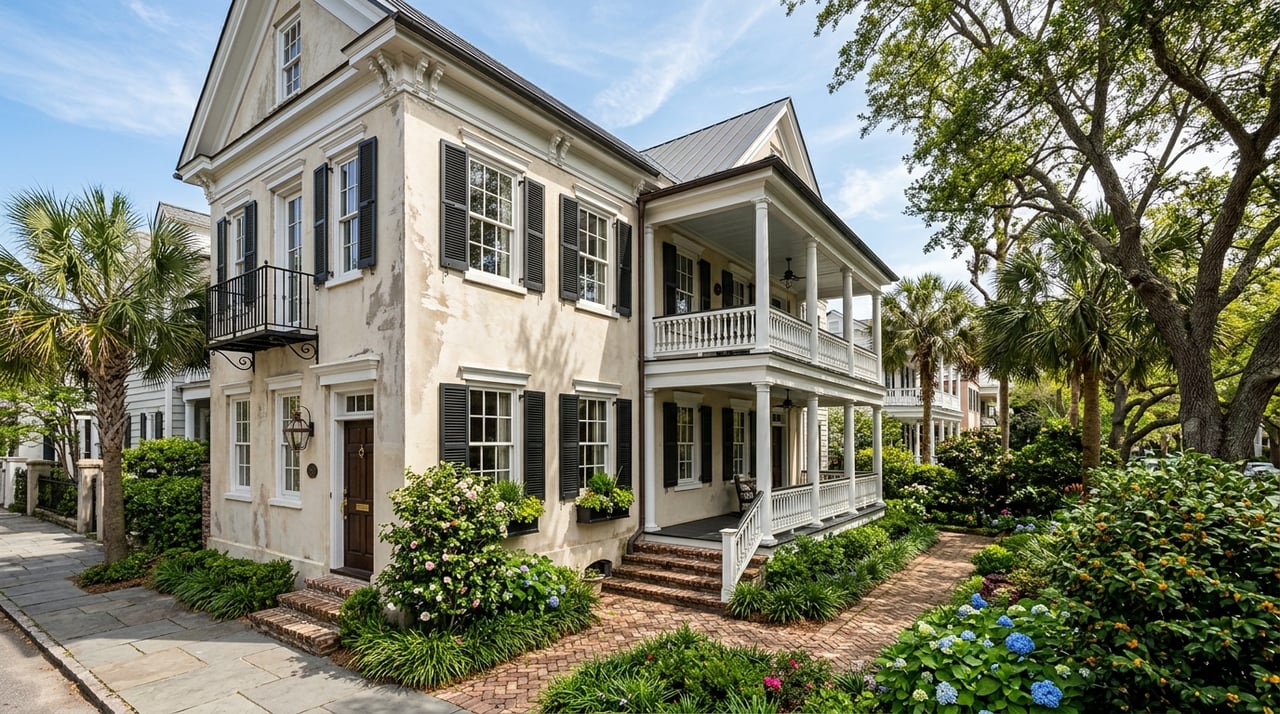
Charleston single houses are one of the city’s best-known home forms. They are typically narrow, with the gable end facing the street, side piazzas, little front setback, and outdoor circulation that helps catch breezes. The city also notes that south-facing piazzas can reduce solar load and help channel air movement.
That said, Hampton Park Terrace is not primarily a Charleston single-house neighborhood. Its historic inventory shows that the most common house type is the Foursquare, followed by front-gable houses. The district also includes bungalows, Prairie-influenced homes, Minimal Traditional houses, and only one Charleston vernacular single house plus six shotgun or Freedmen’s cottages.
So if you are searching for a historic home in Hampton Park Terrace, you are usually looking at early 20th-century suburban architecture rather than the classic single-house form associated with older core downtown blocks. That distinction matters for layout, curb appeal, and renovation priorities.
Renovated bungalows
If you are drawn to character but want a more approachable scale, renovated bungalows are a major part of the Upper Downtown conversation. Bungalows are generally one or one-and-one-half stories, with low-pitched roofs and prominent porches.
In the Upper Peninsula survey, Craftsman and bungalow-influenced houses are described as the most prominent twentieth-century house types. Hampton Park Terrace includes many simple one-story bungalows, while Wagener Terrace and North Central are especially strong markets for buyers focused on this style.
In real-world terms, that means you may find homes with vintage exterior character and updated systems inside. Recent examples include a 1938 Wagener Terrace bungalow that sold for $980,000 after a full update, a renovated brick bungalow in Wagener Terrace that sold for $1.04 million, and a 1939 North Central bungalow described as having new wiring, plumbing, HVAC, and roof.
Townhomes and attached homes
If low exterior upkeep is high on your wish list, townhomes and attached homes may deserve a closer look. In this part of Charleston, they often appear as renovated attached homes or infill units instead of uniform suburban-style communities.
That creates a broad range of options. Some properties are fee simple, while others are set up with an HOA regime. Recent examples in 29403 ranged from an as-is townhome sale at $327,500 to a North Central townhome listed at $523,500 with no HOA, plus Wagener Terrace townhome sales at $703,200 and $760,000.
For you, the takeaway is simple: attached homes in Upper Downtown are less about one standard product and more about specific tradeoffs. Parking, condition, shared walls, and ownership structure can matter just as much as square footage.
How the neighborhoods feel different
Upper Downtown is not one uniform market. Three nearby neighborhoods can offer very different ownership experiences, even when prices overlap.
Hampton Park Terrace
Hampton Park Terrace is a planned suburb of 251 lots laid out in 1912, with most contributing resources built between about 1914 and 1922. Its regular lot sizes, consistent setbacks, and concentrated building period help create a more orderly streetscape than many older downtown blocks.
If you are looking for a neighborhood with a strong early 20th-century identity, this one stands out. Historic here often means Foursquares, front-gable homes, and bungalows rather than classic Charleston singles. It can appeal to buyers who want architectural character with a more cohesive suburban pattern inside the peninsula.
Wagener Terrace
Wagener Terrace offers a broad mix of bungalow-era character and active renovation energy. The city’s Area Character Appraisal describes a wide range of roof forms, cladding, foundations, porches, windows, chimneys, and decorative detailing, which helps explain why the neighborhood feels layered instead of uniform.
This is often a strong fit if you want an established neighborhood with many renovated bungalow options. It can also be a good place to compare detached homes and attached homes side by side, since both appear in the local market.
North Central
North Central is a mixed-use neighborhood with many 20th-century single-home houses and a commercial corridor on King Street. It is also an area where the preservation conversation remains very active.
Historic Charleston Foundation has identified North Central as one of the Upper Peninsula areas most at risk of losing significant historic architecture, and city agenda materials show the North Central Area Character Appraisal being used for BAR evaluation. For you, that can mean a neighborhood with real architectural variety and evolving block-by-block context.
Upkeep and preservation matter
Buying a historic or older home in Upper Downtown is not just about charm. It is also about understanding what kind of work may be expected now and over time.
Charleston’s Board of Architectural Review, or BAR, reviews exterior alterations that are visible from any public right-of-way. The city’s guidelines apply to renovation, rehabilitation, and new construction, and property owners are encouraged to check with staff before beginning work.
That is especially important if you are considering a home with visible updates, deferred maintenance, or future addition plans. A property that looks move-in ready today may still involve design review for later exterior changes.
Common issues in older homes
The historic inventory for Hampton Park Terrace notes common alterations such as siding over original materials, replacement windows, metal porch supports, enclosed porches, and composition shingles. Even with those changes, the district was still found to retain a strong sense of time and place.
For you, that is a useful reminder that many older homes are a mix of original features and later updates. The question is not whether a home has changed, but how those changes affect condition, appearance, and future maintenance.
Renovation choices that fit the area
Wagener Terrace’s Area Character Appraisal offers practical maintenance guidance that buyers should keep in mind. It emphasizes preserving roof forms and ridgelines, keeping original massing, using in-kind repairs, avoiding incompatible materials, and keeping additions small and visually subordinate from the street.
It also warns against changes like painting historic brick or replacing porch railings with contemporary versions. If you are planning improvements, these details matter because they can influence both approval paths and long-term resale appeal.
Flood review should be home specific
Flood risk is another key part of the historic-versus-new conversation in 29403. The City of Charleston says AE and VE zones are high-hazard Special Flood Hazard Areas, while X and X Shaded are lower or moderate hazard areas.
The city also notes that storm surge risk can extend inland and that even low-to-moderate-risk areas account for a meaningful share of flood claims. In other words, broad neighborhood assumptions are not enough.
If you are comparing two homes a few streets apart, the better approach is a parcel-specific review. That is true whether you are looking at a fully restored detached house, a renovated bungalow, or an attached home.
Which home type fits your goals?
In Upper Downtown Charleston, the right choice usually comes down to how you want to live, how much upkeep you want to manage, and where you want to be on the price spectrum.
Historic detached homes
These properties often sit at the top end of the market, especially when they are fully restored. A restored 1914 Hampton Park Terrace property with a carriage house was priced at $2.9 million, and neighborhood pricing has shown very high top-end potential, even if the sample size is small.
This path may fit you if you value architectural identity, originality, and a more individualized floor plan. The tradeoff is that preservation work and exterior maintenance can be more involved.
Renovated bungalows
Bungalows often occupy the middle-to-upper tier of this market. In recent examples, renovated bungalow pricing clustered close to the $1 million mark in both Wagener Terrace and North Central.
This option can make sense if you want historic character in a more manageable footprint. For some buyers, one-level or near one-level living is also part of the appeal.
Townhomes
Townhomes and attached homes offer the widest price spread in Upper Downtown. That range reflects differences in condition, parking, HOA structure, and exact location.
This may be the best fit if you prioritize lower exterior upkeep and a simpler ownership experience. The tradeoffs can include shared walls, less private outdoor space, or HOA considerations depending on the property.
A smart way to compare homes in 29403
When you tour homes in Upper Downtown, it helps to look past the listing photos and compare each property through the same lens. A charming house and a practical house are not always the same thing, and sometimes the best choice is the one that balances both.
Use a simple checklist as you compare options:
- Architecture: Is the style you love actually the style this neighborhood is known for?
- Condition: Have major systems already been updated, or are improvements likely soon?
- Preservation: Are there visible exterior features that may affect future BAR review?
- Flood context: What flood zone applies to this specific parcel?
- Ownership style: Do you prefer detached living or an attached home with potentially less exterior upkeep?
- Price tier: Are you shopping in the top-end historic market, the renovated bungalow range, or the broader attached-home market?
When you answer those questions honestly, your best option usually becomes much clearer.
If you are weighing historic charm against newer finishes in Upper Downtown Charleston, local context matters. The right guidance can help you separate a good-looking home from a truly good fit. When you are ready to compare neighborhoods, review current opportunities, or talk through your goals, connect with Stephanie Wilson-Hartzog for a personalized, high-touch approach to Charleston home buying.
FAQs
What types of historic homes are common in Upper Downtown Charleston?
- In 29403, historic homes can include early 20th-century Foursquares, front-gable homes, bungalows, Prairie-influenced homes, Minimal Traditional houses, and some Charleston single houses, depending on the neighborhood.
What is the difference between Hampton Park Terrace and Wagener Terrace homes?
- Hampton Park Terrace is known for a more orderly early 20th-century planned-suburb layout, while Wagener Terrace has a broader mix of bungalow-era architecture and varied renovation patterns.
Are renovated bungalows common in North Central Charleston?
- Yes. North Central includes many 20th-century single-home houses, and recent market examples show renovated bungalows with major system updates.
Do Upper Downtown Charleston homes need BAR review?
- Exterior alterations visible from a public right-of-way may require review by Charleston’s Board of Architectural Review, so it is important to check before starting work.
Are townhomes in 29403 less expensive than detached homes?
- Often, yes, but the range is wide. Recent attached-home examples in 29403 have varied significantly based on condition, location, parking, and HOA structure.
How should buyers evaluate flood risk in Upper Downtown Charleston?
- Flood risk should be reviewed on a parcel-specific basis because hazard levels can vary by property, and even lower-risk areas can still experience flood claims.